
Professional Dog De-shedding Treatment -- Reduce Shedding by 80% for 4–6 Weeks
Tired of dog hair on your couch, clothes, and floor? Our de-shedding treatment removes loose undercoat before it ends up everywhere. One treatment can change your house.
For dog parents who are done vacuuming hair every single day.
- Fast results
- Lasts 4–6 weeks
- Add to any groom
- 4.6/5 on Google (550 reviews)
- Reduces shedding 80%+
- Serving Brooklyn since 2008
- Works on all double-coat breeds
Your Dog Doesn't Have to Shed All Over Your House
If you have a shedding dog, you know the struggle. Hair on the couch. Hair in your food. Hair stuck to your clothes. Vacuuming twice a day and it’s still everywhere.
The problem is the loose undercoat that’s sitting in your dog’s fur, waiting to fall out. Professional de-shedding removes all that loose hair before it gets on your stuff.
One treatment can reduce shedding by 80% for 4–6 weeks. Your house stays cleaner. Your dog’s coat is healthier. Everyone wins.
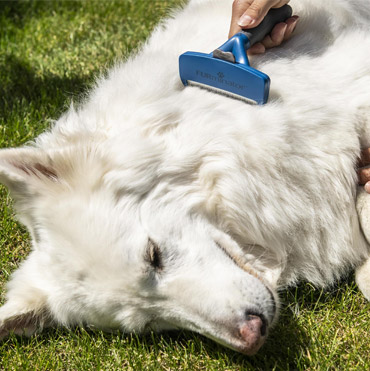
HOW DE-SHEDDING WORKS
What is De-shedding?
De-shedding is a professional grooming treatment that removes loose undercoat from your dog’s fur. It’s not a haircut — it’s a deep clean of the coat.
During a de-shedding treatment, we use specialized tools (high-velocity dryers, undercoat rakes, de-shedding shampoos) to:
- Loosen loose undercoat
- Wash out as much loose hair as possible
- Dry and extract remaining loose fur
- Leave your dog with a clean, healthy topcoat
Result: 80%+ reduction in shedding for 4–6 weeks.
The De-shedding Process Step-by-Step
Step 1: Consultation
We ask about your dog's shedding patterns and coat concerns. Do they shed year-round? Seasonally? Heavily?
Step 2: Pre-Bath Assessment
We check the coat for matting, skin issues, or health concerns that might affect the treatment.
Step 3: Specialized Shampoo
We use a de-shedding or undercoat-reducing shampoo (not regular dog shampoo). This loosens undercoat and prepares for extraction.
Step 4: High-Velocity Drying
This is where the magic happens. A high-velocity dryer (much stronger than a regular hair dryer) blasts out loose undercoat. It's loud but extremely effective.
Step 5: Undercoat Raking
We use specialized de-shedding tools (undercoat rakes, shedding blades) to comb out remaining loose hair.
Step 6: Final Dry & Conditioning
A final conditioning dry to seal the topcoat and leave their fur shiny and healthy.
Duration: 2–3 hours (longer than a regular groom because we’re doing deep extraction)
DOGS THAT BENEFIT FROM DE-SHEDDING
Perfect Candidates (Moderate to Heavy Shedding)
Double-Coat Breeds (the worst shedders)
- Golden Retriever
- Labrador Retriever
- German Shepherd
- Husky
- Malamute
- Corgi
- Saint Bernard
These breeds have two layers of coat — a protective topcoat and a thick undercoat. They shed year-round and heavily seasonally.
Doodle Breeds (if they inherited the double coat)
- Goldendoodle
- Labradoodle
- Bernedoodle
- Aussiedoodle
Some doodles have poodle-like single coats (low-shedding). Others have double coats and shed heavily. If your doodle sheds a lot, de-shedding helps.
Other Moderate-Shedding Breeds
- Pomeranian
- Chow Chow
- Akita
- Samoyede
- Newfoundland
- Old English Sheepdog
Dogs That Don't Need De-shedding
Single-Coat Breeds (minimal to no shedding)
- Poodle
- Portuguese Water Dog
- Bichon Frise
- Maltese
- Shih Tzu
- Yorkshi Terrier
These breeds shed very little and don’t have a thick undercoat. De-shedding won’t help because there’s no undercoat to remove.
Short-Coat Breeds (light to moderate shedding, but minimal loose undercoat)
- Lab (ironically, despite being a heavy shedder, de-shedding is less effective than regular grooming)
- Pit Bull
- Boxer
- Beagle
SEASONAL SHEDDING GUIDE
Season |
Timeline |
What Happens |
Best Approach |
Frequency |
|---|---|---|---|---|
|
Spring Shedding (Peak) |
March–May |
Dogs "blow their coat" -- shed winter undercoat to prepare for summer |
De-shedding treatment in April. One treatment during peak season reduces shedding for entire spring/early summer |
1–2 treatments during spring |
|
Summer |
June–August |
Minimal shedding if spring de-shedding done; light shedding if not |
Regular grooming or bath. De-shedding less necessary |
As needed |
|
Fall Shedding (Secondary Peak) |
September–November |
Dogs prepare for winter by growing thicker coat. Another minor shed cycle |
Optional de-shedding treatment in October if shedding picks back up |
1 treatment in fall (optional) |
|
Winter |
December–February |
Minimal shedding. Dog has thick winter coat |
Regular grooming only. No need for de-shedding |
Regular maintenance only |
WHAT TO EXPECT AFTER DE-SHEDDING
Timeline |
What Happens |
|---|---|
|
Immediately After (Days 1–3) |
Your dog's coat will look fuller and healthier. They might shed slightly more in the first few days (this is normal as the last loose hairs fall out). Then shedding drops dramatically. |
|
Week 1–2 |
Noticeable reduction in household hair. Your vacuum will have less to pick up. Clothes stay cleaner. |
|
Week 2–6 |
Shedding remains minimal. Your house stays noticeably cleaner. Your dog's coat looks shiny and healthy. |
|
Week 6–8 |
|
TESTIMONIALS
EXCELLENTTrustindex verifies that the original source of the review is Google. I take my cat here to get his nails trimmed and they take walk-ins! They are very friendly and efficient and do a great job with my cat’s nails. Couldn’t recommend the enough.Posted on GoogleTrustindex verifies that the original source of the review is Google. Brooklyn Pet Spa Pet Grooming Brooklyn is friendly, clean, and super convenient. I had a slightly complicated schedule and they were able to accommodate me!! The staff are welcoming, and drop‑off is easy. My dog always looks great after dog grooming. Highly recommend.Posted on GoogleTrustindex verifies that the original source of the review is Google. I’ve been going to Brooklyn Pet Spa for about 5 years now and I value and appreciate this establishment dearly. I’ve never had not one issue with grooming when it came to my dog for the 5 years I’ve been going to Brooklyn Pet Spa. Any specific requests I made before dropping my dog was accommodated flawlessly. They really bring out the cuteness from my dog and I’ve been getting compliments since I got my dog due to how great he’s groomed. If you’re reading this book the appointment ESPECIALLY if you have a poodle. They will make your dog look like it belongs on a commercial! Thank you Sandro & the brooklyn pet spa team I’m so glad I found you guys!Posted on GoogleTrustindex verifies that the original source of the review is Google. I am thrilled to share that I recently became the madrinha de três afilhados in Brasil. Minhas duas menininhas: 12-year-old Ana and 5-year-old Hadassa. (I love using these affectionate Portuguese terms!). Of course, I can't forget my 14-year-old, Pedro, who wants to be a professional futebol player. Ana has dreams of becoming a veterinarian, while little Hadassa wants to drive a big truck, to help me with my volunteer work. I wanted to introduce them to the enchanting American holiday of Halloween, and involving my beloved fur babies made it even more special. To share this moment, I reached out to a spa employee, who kindly sent me a photo of my dog being groomed, reminding us of the importance of reliable pet grooming for our pets' well-being and happiness. My best friend has a toy poodle from the Champion line of show dogs, with pedigree parents in Denmark. Upon returning to the U.S., she sought out a Master Groomer but was disappointed after trying several different places in less than six months. Unfortunately, the constant changes caused her dog so much stress that it had colitis (bloody stools), according to her Vet. This experience taught her—and me—the importance of finding a reliable groomer. I've been using Brooklyn Pet Spa for three years, since my dogs were puppies. Sandro recommended using a #7 clip for my dogs, which is safe and breed-appropriate. I switched from #10 to #7, knowing it promotes coat health. The Miniature Schnauzer show dog at the AKC Meet the Breeds was also cut with a #7, confirming its suitability. Sandro's breed-specific grooming expertise ensures my dogs look their best and stay healthy, especially Naomi, who has occasionally skin irritation from environmental allergies. Proper grooming not only keeps them looking great but also helps maintain their health and comfort. The photos of my dogs, just one week after grooming, show how well the grooming was done—they look fabulous! Someone should call William Galharde because my fur babies are more than ready for their close-up!Posted on GoogleTrustindex verifies that the original source of the review is Google. Brooklyn Pet Spa Pet Grooming Brooklyn is the only place I feel comfortable taking my son aka little dog. The owner is awesome and makes me feel so comfortable. The groomers are really skilled and the whole dog grooming process is quick and convenient. My pet always comes home looking and feeling great.
Frequently Asked Questions (FAQs)
Typically 4–6 weeks of significantly reduced shedding. After that, new undercoat starts growing in and shedding gradually returns. Most heavy-shedding dogs benefit from 2–3 treatments per year (spring, early summer, fall).
No. High-velocity drying and undercoat removal won’t damage the topcoat. It’s a professional technique that’s completely safe. Your dog’s coat will actually be healthier because you’ve removed dead undercoat.
Yes. It’s not invasive or stressful. Senior dogs might need extra breaks during the long drying process, but the treatment itself is safe. We can accommodate senior dogs with breaks if needed.
Yes. Brushing between treatments (especially during non-peak shedding) helps maintain the results and prevents matting. A simple weekly brush keeps everything tidy.
Yes. We use gentle, hypoallergenic de-shedding shampoos. Let us know about skin sensitivities when you book and we’ll use the appropriate shampoo.
Ready to Reclaim Your Home from Dog Hair?
Book a de-shedding treatment and see the difference. Most dogs are on the schedule within the same week.
- 4.6/5 on Google (550 reviews)
- Reduces shedding 80%+
- All double-coat breeds
- Serving Brooklyn since 2008
THE LION CUT PROCESS
Professional Styling
Assessment
We check your cat’s coat for matting, skin issues, and overall health.
Trimming
We carefully trim the body to 1/4–1/2 inch, leaving the ruff, head, and tail fluffy.
Finishing
Paw shaping, tail tip, and detail work to create that signature lion look.
Gentle Handling
Cats can be anxious during grooming. We work at their pace and offer breaks.
Duration
1.5–2.5 hours (depends on coat condition and cat’s stress level)
CARE AFTER LION CUT
First Few Days
Adjustment Period
Your cat might feel cold or vulnerable at first. This is normal. Provide warm bedding and extra reassurance.
Monitor for Chafing
Watch for any irritation where the short hair meets the longer ruff. Report any issues to us.
Avoid Bathing
Don't bathe your cat for at least 2–3 days after the cut to allow skin to settle.
Ongoing Maintenance
Brush the Ruff
Brush the fluffy head and neck area regularly to keep them mat-free.
Trim Schedule
Lion cuts grow out over 2–3 months. Many cat parents re-book every 8–12 weeks during warm season.
Avoid Cold
If it's cold out, keep your cat indoors. They lose their insulating coat.
